Private Collection, Japan
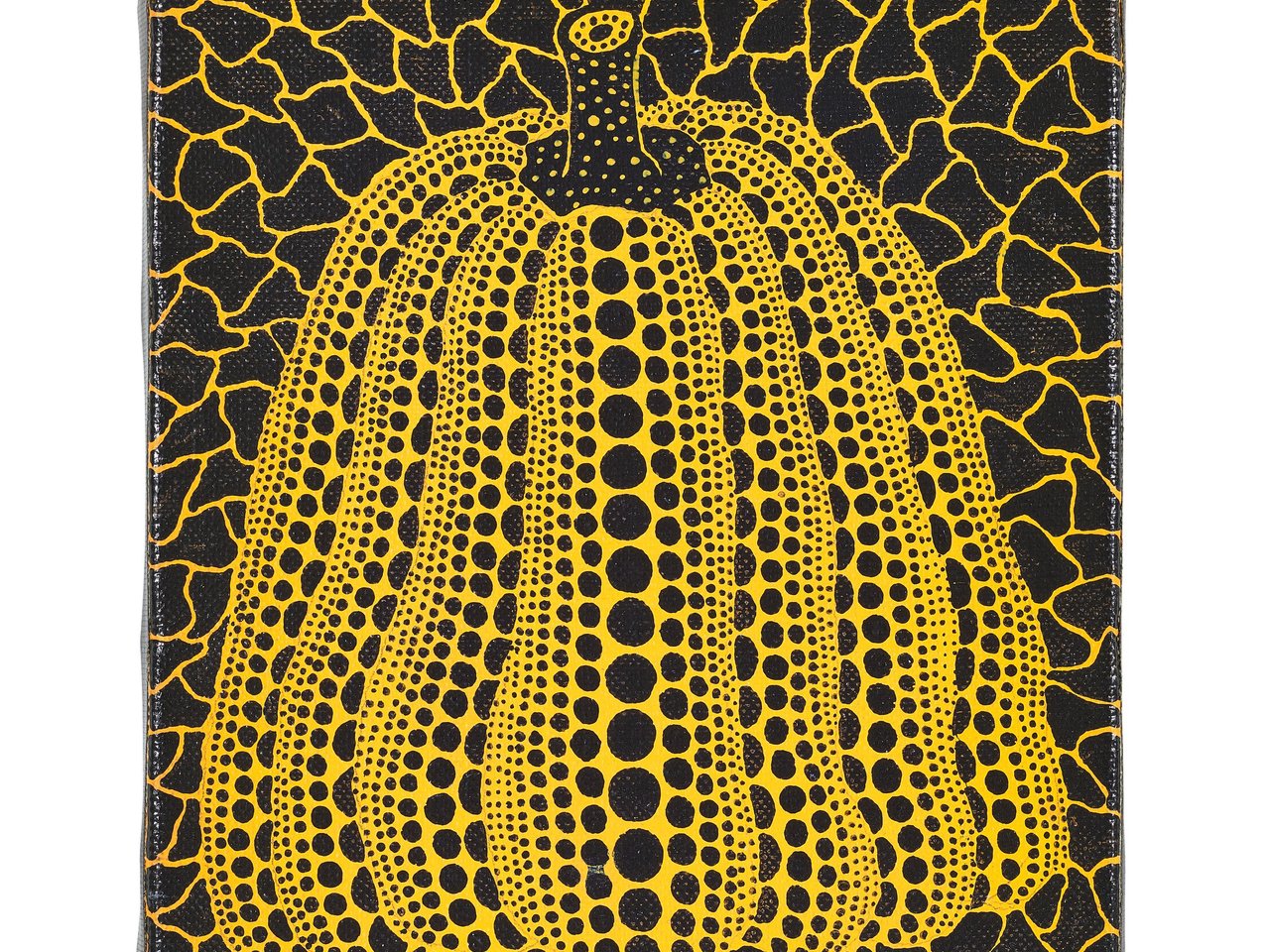
南瓜
壓克力 畫布
1990年作
簽名:Yayoi Kusama 1990 かぼちゃ(背面)
此作附草間彌生株式會社開立之登錄卡
日本私人收藏
presents a carefully curated visual symphony of six masterpieces spanning various themes and mediums. Yayoi Kusama, who emerged on the international art scene in the mid-20th century and has since become one of the most influential artists globally, has long mastered the powerful use of color alongside her emphasis on concept, form, and material. Leading this collection is a deeply evocative red pumpkin painting, which resonates and harmonizes with other works on canvas, sculptures, and prints in different colors, showcasing the rich diversity of Kusama"s artistic spirit.
Throughout centuries of evolution in visual arts, color has transcended its role as a mere accessory to subject, technique, and composition to become a core element that speaks directly to the depths of human spirit and emotion. Nineteenth-century Impressionist painters broke traditional constraints by using color to capture fleeting moments of light and shadow. Henri Matisse further liberated the individual character of color, and within the context of post-war contemporary art, color became an independent language for artists to express themselves and transmit spiritual power. When Kusama rose to prominence in the American contemporary art scene in the 1960s, she already viewed color as an independent visual language, leading to her development of monochromatic abstract paintings. Archival photographs reveal that red was her most favored color alongside white, and its magnetic appeal has been fully realized through her astonishing creativity.
In color theory, red possesses an inherent visual advantage and emotional tension that establishes its irreplaceable core position in artistic creation. This status stems from its physical properties and the diverse symbolic meanings assigned to it by various cultures. In East Asian cultures, red primarily symbolizes the sacred, authority, celebration, auspiciousness, and the power to ward off evil. From religious architecture and traditional festivals to daily customs, red plays an essential, transcendent role. In Western art history, red serves as a symbol of sublimity and salvation in religious paintings, as well as a vehicle for expressing rebellion, freedom, and emotional catharsis in modern art.
Throughout art history, countless masters have left iconic works using red as their medium. In Assumption of the Virgin (1516-1518), Titian masterfully uses red as a visual bridge connecting God, the Virgin Mary, and the apostles, allowing viewers to intuitively experience the solemnity of religious faith. Matisse"s masterpiece The Red Studio fills the space with red, eliminating all illusions of perspective and depth to highlight the pure power of color. Mark Rothko"s use of red pushes emotional expression to its absolute limit; his vivid reds evoke warmth, passion, and religious ecstasy. This immersive expression of "color as emotion" creates a cross-temporal dialogue with Kusama"s application of red.
"One day, I was looking at the red flower patterns of the tablecloth on a table, and when I looked up I saw the same pattern covering the ceiling, the windows, and the walls, and finally all over the room, my body and the universe. I felt as if I had begun to self-obliterate." This recollection from Kusama illustrates how red became a color of destiny for her.
To understand Kusama"s "red," one must return to the artist"s unique life experiences. Since childhood, she has been accompanied by severe hallucinations and psychological distress. These visual experiences-especially the endlessly proliferating polka dots and net structures-became the most primal driving force and source material for her art. Her art is a magnificent, lifelong ritual of externalizing and mastering her inner visions. Every color on her canvas, particularly the dominant red, is a direct manifestation of her internal landscape.
This red is the burning sensation of nerve endings and an eruption of life force. Red is intimately connected to Kusama"s philosophy of "self-obliteration," permeating every corner of the canvas and linking the pumpkin with the patterned nets in the background. This facilitates a natural process of fusion between the subject and its environment. Kusama views each mesh of the net as a dot element that makes up the vast universe. Therefore, the pumpkin is not an isolated entity, but rather one with all things in the cosmos.
Alongside the abstract "Infinity Nets," the pumpkin is undeniably Kusama"s most recognizable motif. It is not merely a subject for still-life painting, but rather serves as the artist"s spiritual symbol and alter ego, connecting her childhood memories to the infinite universe. The birth of this symbol is rooted in her background growing up in a Japanese family that managed a seed nursery, where the pumpkin was the most familiar and comforting presence among the plants. In her memory, pumpkins are round, full, and resilient, possessing a robust vitality despite lacking a glamorous exterior. These characteristics perfectly align with her own personality, making the pumpkin a concrete projection of her inner world.
The Kusama pumpkins most familiar to the public are predominantly yellow. The warm, bright hue gives them a strong sense of affinity, establishing them as an iconic hallmark. In 1993, at the Japanese Pavilion of the Venice Biennale, Kusama presented a mirror room reflecting an infinite number of yellow pumpkin sculptures-an image that has become a classic in contemporary art history. Objectively speaking, red pumpkins are much rarer, and compared to their yellow counterparts, they project an innate sense of nobility and commanding presence.
The reason Kusama"s pumpkin has become a global icon of contemporary art is deeply tied to the historical context of the Pop Art movement. Kusama"s pumpkin and Andy Warhol"s Campbell"s Soup Cans are among the most representative "everyday symbols" in post-war contemporary art history. In the 1960s, Pop Art blurred the boundaries between high and low culture by drawing inspiration from daily life and employing flattened, symbolic techniques to reconstruct aesthetic values. Kusama"s pumpkin paintings shed the objective constraints of depth and chiaroscuro, condensing into highly recognizable symbols. Furthermore, in most instances, Kusama"s pumpkins occupy the central focus of the composition, elevating the work from a mere still life to a portrait of the artist herself.
While sharing the same motif, every pumpkin work is a unique individual. Much like human beings, they possess distinct personalities and forms. Some are elongated, others are perfectly round; some tilt slightly to suggest motion, while others sit squarely in balanced composure. A close examination of the undulating curves, the density of the polka dots, and the rhythm reveals crucial personality differences within the same subject. It is this "difference within similarity" that allows the pumpkin to be both a memorable mass symbol and a vessel retaining the trace of the artist"s hand and spiritual warmth.
While Andy Warhol"s Campbell"s Soup Cans emphasize reproduction and standardization to reflect on consumer society, Kusama emphasizes uniqueness and spirituality. By utilizing the pumpkin as her avatar and spiritual totem, she diverges from standard commercial reproduction. Even within the visual language of Pop Art, her pumpkins secure an irreplaceable position in contemporary art history through their profound spiritual substance.
acts as a prism, allowing us to glimpse the vast and profound creative universe behind a single iconic red masterpiece. Each work serves as an entryway leading to the same spiritual realm of life, memory, obsession, and eternity. This is not simply an assembly of artworks, but a rare, systematic aesthetic experience, inviting collectors to step into Kusama"s infinitely repetitive yet boundlessly rich artistic domain.
本次拍賣專場「不止於紅︰草間彌生日本單一藏家珍藏」共呈現六件跨主題和媒介的精品,組成了一場經精心編排而成的視覺交響。草間彌生二十世紀中期開始活躍於國際藝壇,後來並成為全球最具影響力的藝術家之一。她的創作不只強調觀念、造型和物料,長久以來更擅於運用顏色的強大力量。領銜本次專場,即是一幅極富感染力的紅色南瓜繪畫,配合其他色彩的布上作品、雕塑和版畫產生和鳴與變奏,展現出草間彌生豐富多元的藝術精神面貌。
視覺藝術經歷數百年來的不斷演變,顏色早已非題材、技法與構圖的附屬品,而是直抵人類精神與情感深處的核心元素。十九世紀印象派畫家打破傳統桎梏,以顏色捕捉光影瞬間,經歷馬蒂斯進一步還原色彩的個性,再到戰後當代藝術語境下,顏色成為藝術家表達自我,傳遞精神力量的獨立語言,其主體性地位不斷凸顯。草間彌生早在1960年代崛起於美國當代藝壇之時,已經開始視色彩為一項獨立的視覺語言,從而發展出單色抽象繪畫;從檔案圖片中可見,當時紅色,更是白色以外最受她青睞的對象。紅色的魅力,被創造力驚人的草間彌生發揮得淋漓盡致。
從顏色理論而言,紅色作為三原色之一,其天生的視覺優勢與情感張力,奠定了它在藝術創作中不可替代的核心地位。這種地位既源於其物理屬性,更源於人類文明中不同文化賦予它的多元象徵︰在東亞地區如中國和日本的文化中,紅色主要象徵神聖、權威、喜慶、吉祥以及驅邪避厄的力量,從宗教建築、傳統節慶到日常習俗,紅色都扮演著不可或缺的超然角色。而在西方藝術史中,紅色既是宗教繪畫裡象徵崇高與救贖的顏色,亦是現代藝術中表達叛逆、自由與情感宣洩的載體。
翻開藝術史,無數大師以紅色為媒介留下經典。提香在《聖母升天》(Assumption of the Virgin,1516-1518)中,巧妙地運用紅色作為視覺引導的橋樑,把上帝、聖母和使徒連結,讓觀者直觀感受宗教信仰的莊嚴。馬蒂斯的代表作《紅色工作室》以紅色填滿了空間,消除一切有關透視和深度的幻象,彰顯顏色的單純力量。馬克.羅斯科對紅色的運用則將情感表達推向極致,他筆下的鮮紅帶來溫暖、激情與宗教般的狂喜。這種「顏色即情緒」的沉浸式表達,與草間彌生對紅色的運用形成跨越時空的呼應。「某日我看到桌布的紅色花紋,再轉移視線後居然發現無論是天花板、玻璃窗、柱子都出現一模一樣的花紋,整個房間都是,甚至連我的身體也充滿花紋,在當時,我產生自我消融的感覺。」從她這段回憶的說話可見,紅色成為了一種帶有宿命性的顏色。
要理解草間彌生的「紅」,必須回歸到藝術家獨特的生命經驗。自童年時代起,她便為嚴重的幻覺與精神困擾所伴隨。這些視覺經驗--特別是無窮蔓延的圓點、網狀結構--成為了她藝術創作最本源的動力與素材。她的藝術是一場窮畢生之力,將內心幻象外化並予以駕馭的壯麗儀式。她畫布上的每一種顏色,尤其是具有統治力的紅色,都是其內在景觀的直接彰顯。這種紅是神經末梢的灼熱感,是生命力的噴發。紅色與草間彌生「自我消融」的哲學緊密相連,紅色滲透在畫面的每一個角落,連繫了南瓜的本體與背景上的網紋,把兩者進行了一場自然的融合過程。草間彌生視每一個網格為組成浩瀚宇宙的一點一點元素,因此南瓜不是孤立的存在,它與天地萬物合而為一。
除了抽象的「無限的網」,南瓜肯定是草間彌生具辨識度最高的主題。南瓜不是一種簡單的靜物繪畫題材,它更像是藝術家的精神象徵與自我化身,是連繫童年記憶與無限宇宙的情感紐帶。這一符號的誕生源於她的成長背景--她出生於日本一個經營種植業的家庭,自小與各類植物相伴,而南瓜便是其中最親切溫暖的存在。在她的記憶中,南瓜圓潤飽滿、堅韌不屈,無華麗外表卻有強大生命力,這種特質與她自身性格高度契合,成為其精神世界的具象投射。
世人熟悉的草間彌生南瓜多以黃色為主色,溫潤明亮的色調使其甚具親和力,成為經典標誌。1993年草間彌生在威尼斯雙年展日本館,曾以鏡房反射出無限的黃色南瓜雕塑,成為了當代藝術史中一個經典景象。客觀來說,紅色南瓜更顯稀有,而相對黃色南瓜,亦另見一份與生俱來的尊貴和氣勢。
草間彌生的南瓜之所以能成為全球當代藝術經典符號,沿襲了波普藝術運動的時代背景。南瓜與安迪.沃荷的金寶湯罐,均是戰後當代藝術史上最具代表性的「日常象徵」符號。二十世紀60年代,波普藝術打破高雅與通俗的界限,藝術家從日常生活中汲取靈感,以平面化、象徵化、可識別的手法,重構藝術審美,反映戰後消費社會文化特色。草間彌生的南瓜繪畫,擺脫了景深和明陰的客觀框架,濃縮為一個高辨識度的符號。而在大部分情況下,草間彌生筆下的南瓜都充滿了構圖的重心位置,令作品不單作為靜物的主題呈現,更可視作一幅代表藝術家的肖像。
每一件南瓜作品,雖共享同一主題,卻都是獨一無二的個體。它們如同人類,擁有各自鮮明的「性格」與「形態」。有的修長、有的圓滿;有的微微傾斜帶著動勢,有的平衡端坐顯得沉著。若細看輪廓曲線的起伏與圓點的密度、邊界與節奏,便會發現同一母題之下存在微妙而關鍵的性格差異;也正是這種「同中有異」,讓南瓜既能成為大眾可記憶的符號,又能保有藝術家手工與精神溫度的痕跡。安迪.沃荷的金寶湯罐強調複製與標準化,是對消費社會的反思。草間彌生則強調獨特性與精神性,將南瓜作為自我化身與精神圖騰,即便同屬波普的語言範疇,仍以獨特精神內涵在當代藝術史中佔據不可替代的地位。
「不止於紅」猶如一扇多棱鏡,讓我們透過一件標誌性的紅色傑作,窺見其背後廣闊而深邃的創作宇宙。每一件作品都是一個入口,通向同一個關於生命、記憶、執念與永恆的精神世界。這不僅是一系列作品的匯聚,更是一場難得的、系統性的審美體驗,邀請藏家步入草間彌生那無限重複又無限豐饒的藝術之境。