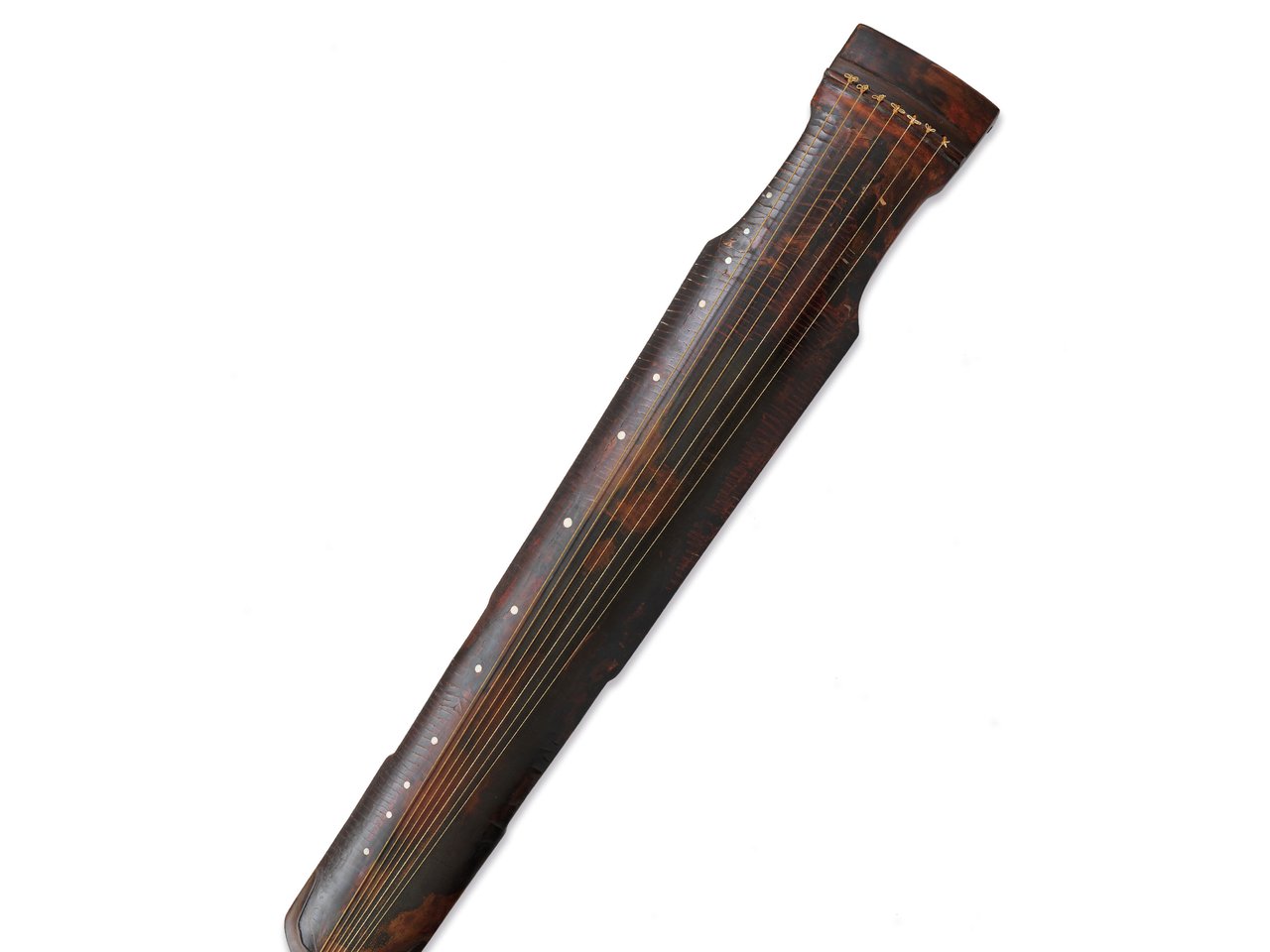
The qin is of Confucius style, gracefully waisted along two ends of the body, the upper surface gently convex and inlaid with mother-of-pearl studs, hui. The underside has two rectangular sound holes, termed as longchi 'dragon pool' and the smaller as fengzhao 'phoenix pond'. The name of the qin is incised above the 'Dragon Pool', Shuangtian lingduo, 'Bells on a frosty day'. Two ten-character inscriptions in running script are carved on either side of the ‘Dragon Pool’, which can be translated as: ‘crisp, smooth, buoyant, rich, its sound reverberates like a bell on a frosty day; harmonious, pure, distinct, unceasing, it sings the golden age of Yao and Shun’. Below the ‘Dragon Pool’ are three carved seals. The first is a two-character seal arranged in the shape of a bell reading Huangnan, the pseudonym of Prince Yi. The second is four-character seal reading Yifan yazhi (elegantly made for the Fief of Yi). The third seal reads Youcheng yangde (rejoicing in sincerity, nurturing virtue). The instrument's strings are threaded through seven tasselled tuning pegs made of buffalo horn. Each string is arranged over the upper surface and tied to either of the two hardwood pegs. The lacquer surfaces are suffused with ‘serpent-belly’ cracks admixed with ‘flowing-water’ crackles.