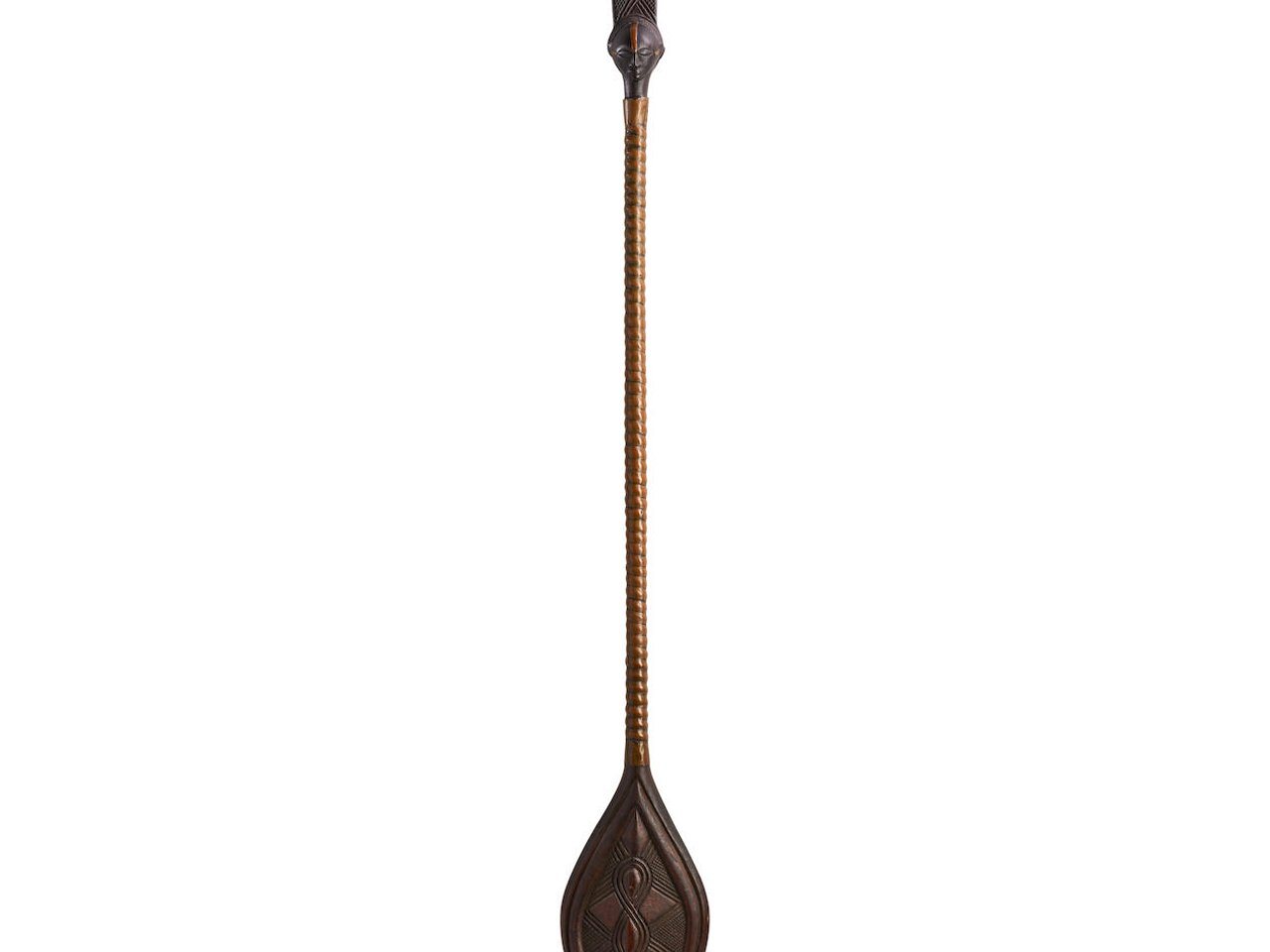
"Dibulu, the broad sections of Luba staffs, represent the administrative centers that are part of every royal capital. The dibulu often takes the form of a triangle, a diamond, or an hourglass shape, and is always engraved with the same geometric patterns found on the backs of lukasa memory boards. The long, unadorned, or copper-wrapped shafts represent uninhabited savannahs and signify the roads leading to the administrative centers of the kingdom." (Roberts, Mary Nooter and Allen Roberts (Ed.), Memory - Luba Art and the Making of History, The Museum for African Art, New York, Prestel, 1996, p. 173.
Cf. (Ibid.) Cat. 70
Finely carved with a broad triangle at the top with incised curvilinear design on both sides resting on the top of janus heads, each with copper accents on the temples and each forehead (one missing), representing the twin tutelary spirits of Luba kingship, Mpanga and Banze, a long cylindrical shaft wrapped in copper, ending in a rounded dibulu with an incised curvilinear design on each side; fine black patina with faint oozing of ritual patination.