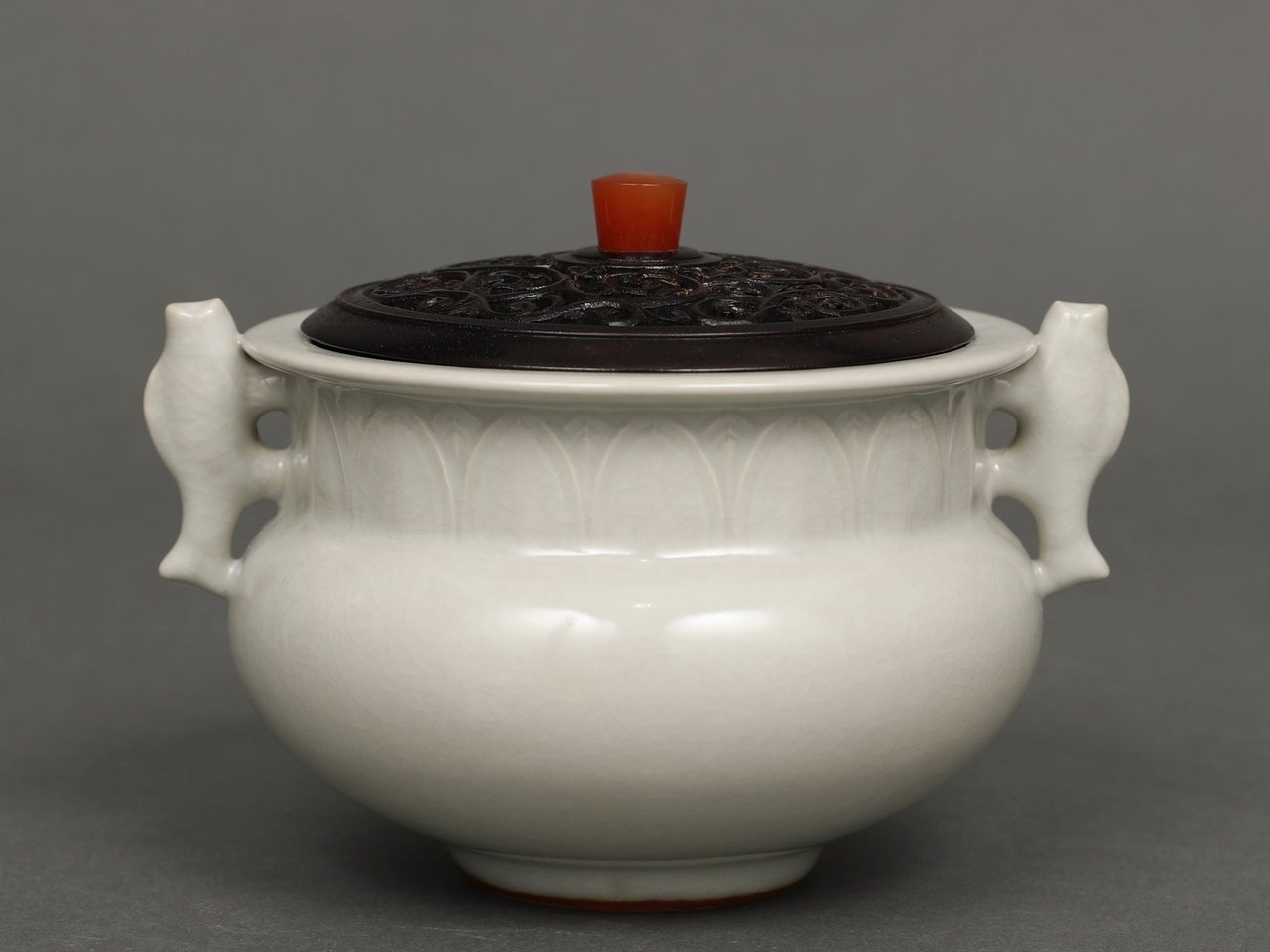
This work, carp ear incense burner, is thought to be made of ice flower porcelain with a slightly bluish glaze over white porcelain. Hazan's white has subtle differences in color and sharply differentiates shades and names, but from various angles you can see the depth of gray and greenish colors. The incense burner has a wide rim. The sharp, straight lines are reminiscent of the Art Deco style. The carp ears attached to the short neck protrude higher than the mouth as if they were adorable and stretched, showing a strong presence. An arabesque pattern is carved on the firehouse made of rosewood, and the knob on the top is decorated with agate. It is believed that Hazan continued to stick to auspicious patterns not only because of their beauty, but also because they embodied his prayers that healed the hearts of those who saw them and wished for their happiness. Hazan survived the turbulent Meiji and Showa eras and left behind exquisite ceramic works of unparalleled beauty. He created a unique world of pottery by carving out patterns in minute relief using thin-walled engraving techniques, applying colored glaze on top, and matting the glaze to softly envelop the light. Hazan elevated ceramic artists, who at the time were regarded as craftsmen, to artists, and in recognition of these achievements, he became the first ceramic artist to receive The Order of Culture in 1953. Also known for his research into the art nouveau style of Western ceramics, Hazan's art ceramics pursued light in the same way as painters and writers of the same era, and modern Japan embraced art and literature based on the principle of praising life. It can be said that it was nurtured and blossomed in art.