ANDY WARHOL
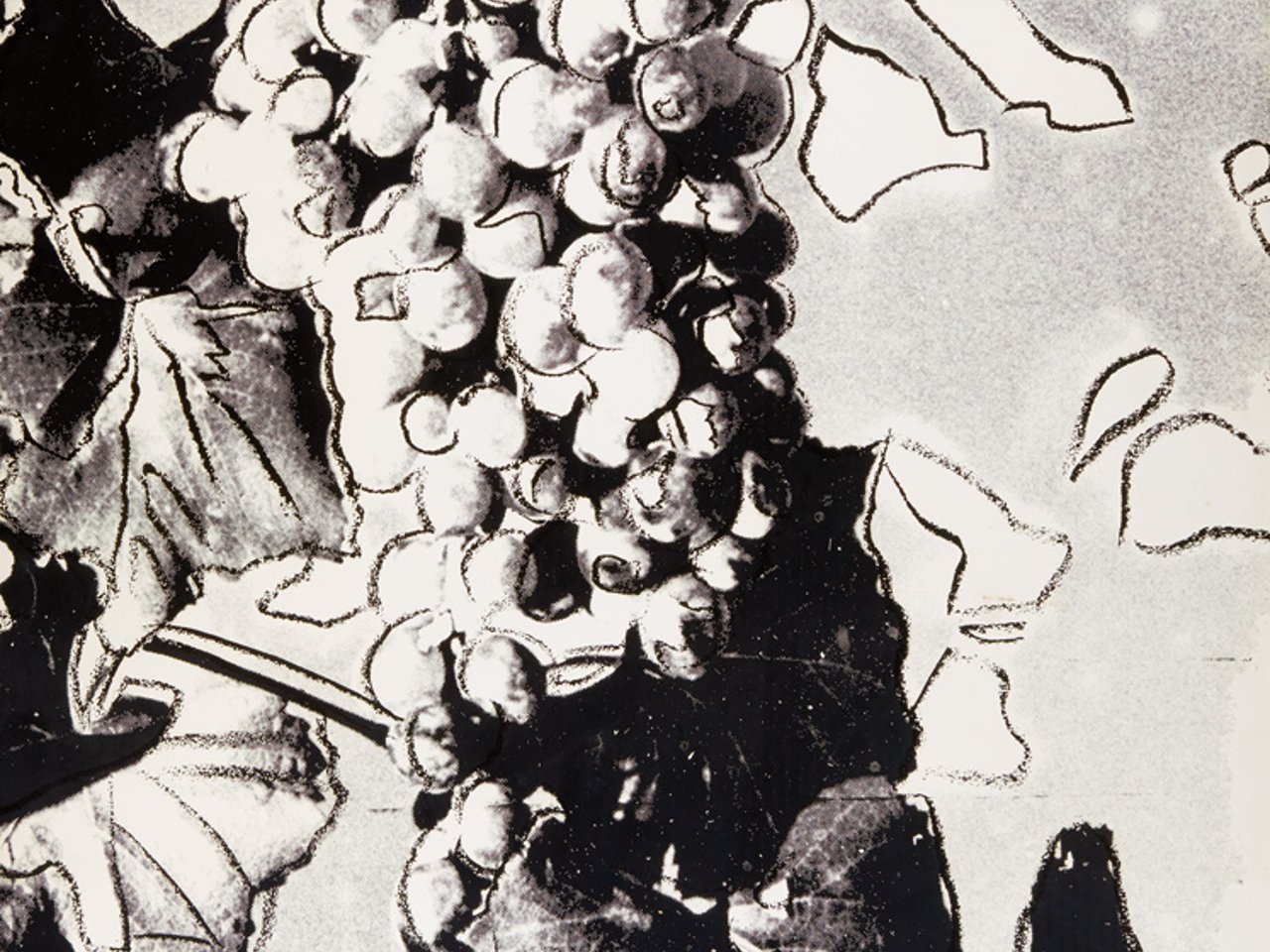
Grapes (Black) .
Screenprint printed in black on Strathmore Bristol paper, 1979. 1016x762 mm; 40x30 inches, full margins. A unique trial proof of the black screen only, before the color screens and diamond dust. Strathmore Bristol blind stamp, lower right. Printed by Rupert Jasen Smith, New York. Published by Andy Warhol Enterprises, Inc., New York. A richly-inked impression of this very scarce proof.
Following his self-professed "retirement" from painting in 1966, Warhol became very involved in the burgeoning prints market, establishing his own printing/publishing company, Factory Additions, in New York, and producing what is perhaps the largest, most recognized printed ouevres among his Pop Art contemporaries. From the outset of his printmaking career he had incorporated screenprinting, adopted from common advertising practices like signage and poster making, further developing this rather mundane process, from one edition to the next, with ever more complex results.
According to De Salvo, "One of the most conceptually provacative developments of the 1970s was the greatly expanded use of unique edition prints," approximately two-thirds of Warhol's screenprinted output of the 1970s is unique editioned prints, "screenprints illustrating the subtle variations and permutations that Warhol was able to achieve through his expanded notion of the printing process. A unique print, with no duplicate, pushed the aesthetic and economic bounderies that traditionally defined prints as identical units. Although a precedent for Warhol's method can certainly be found in artistic uses of the monoprint, that process had not been intended to produce the large numbers that were possible through silkscreen," (Andy Warhol Prints, New York, 1985, pp. 24-25).
Warhol's repeated use of floral motif in printmaking dates back to around 1961, when he produced one of his characteristic blotted-line ink drawings of a basket filled with Mexican flowers, over which he hand-stamped watercolor petals on the flowers, to secure an illustration commission from Vogue magazine. With his meteoric rise to international artistic popularity in the early 1960s Warhol made one floral still life edition after another: Flowers , offset color lithograph, 1964, created to announce his exhibition at Leo Castelli Gallery, New York (see lot 168); the Flowers suite of 10 color screenprints, 1970 (see lot 166); and the Flowers series of 10 black and white screenprints, 1974, each with unique hand coloring in watercolor; culminating in this series of Grapes , 1979, a suite of six differently arranged bunches of grapes, branches and leaves overlayed with the artist's signature blocks of color and dark black contour lines. Feldman 191 (and 191 A).