Voyager Books, Brisbane
Private collection, Brisbane
In 1851 the discovery of gold in New South Wales and Victoria sparked goldrushes that were to dramatically change the course of Australia"s colonial past. Hundreds of thousands rushed to the goldfields including immigrants from all over the world, transforming Australian society and modernising its cities. James Esmond is credited with the first official find in Victoria in the town of Clunes in 1851. Word of his discovery travelled quickly and soon significant finds in Ballarat, Castlemaine, Bendigo and several other towns followed. Ballarat was considered the world"s richest alluvial goldfield during its peak between 1852-1853.
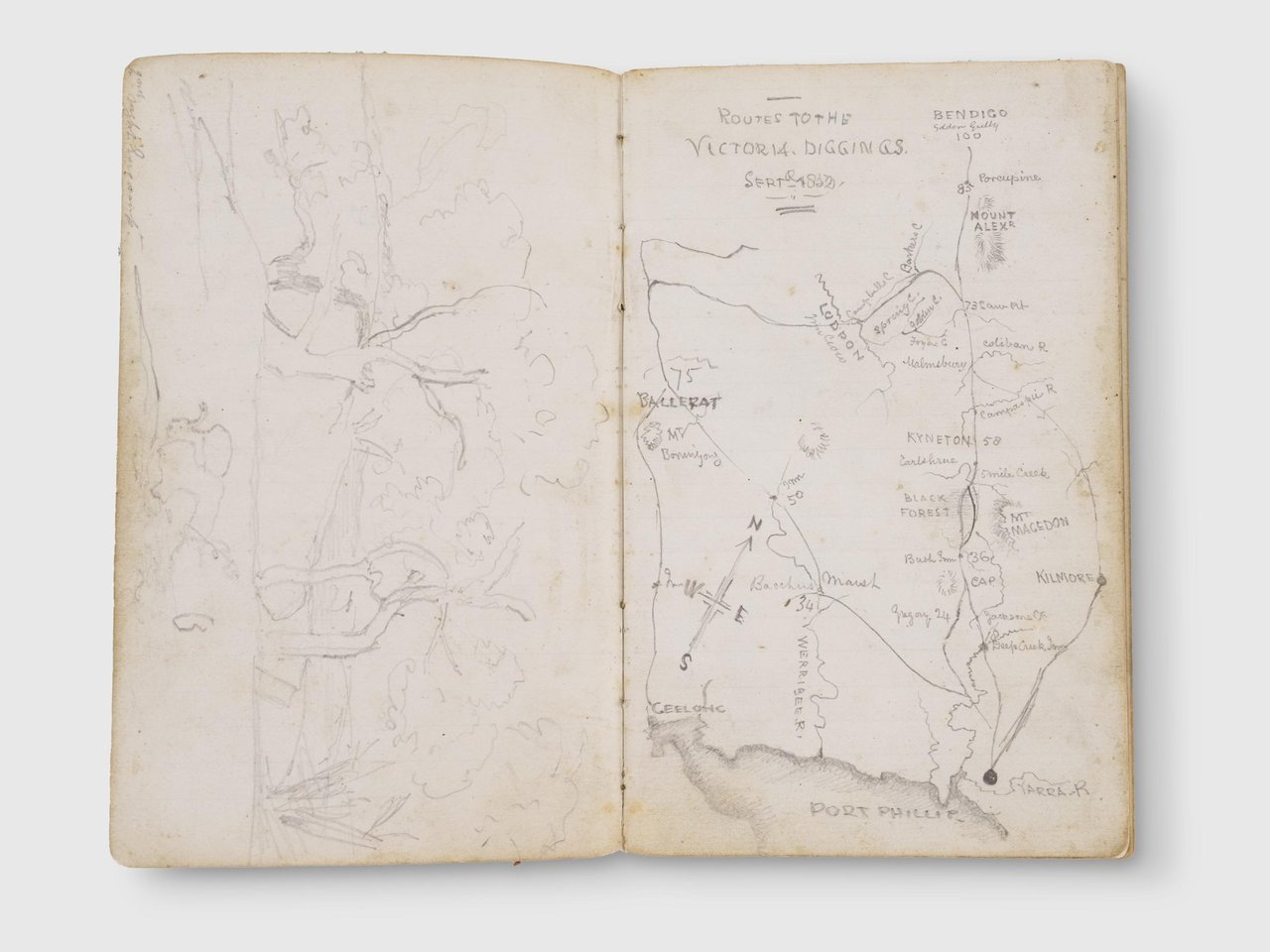
The anonymous author of this diary packed his belongings in readiness for his journey to the Victorian goldfields on 29th September 1852, making his way to the village of Flemington in Melbourne. From there he travelled through the ranges near Mt Macedon, then through the Black Forest on the way to Kyneton, then crossed the Coliban River before arriving at Moonlight Gully on 12th October. On 13th he and his party picked out their claim and gained their gold digging licences on 14th October. Having taken almost two weeks to reach their destination, their search for fortune was about to officially begin.
After a relatively difficult journey with muddy terrain that hindered the dray (a cart which is illustrated in one of the sketches), fallen trees, some steep ascents and straying horses, life in the diggers camp too was filled with its own challenges. The author describes cold weather and recurring bouts of dysentery, unreliable water supply as well as constant problems with equipment breakages and flooding digging holes. There are moments of levity too:
"We got into beautiful country again...camped on top of the hill overlooking a branch of the Coliban. Saw Mt Alexander on the opposite side in the distance" (9th October)
"Spent a quiet comfortable Xmas day. Had roast beef, plum pudding and rum and spent the even at Littlewoods tent where we indulged in port" (25th December)
Overall, his fortunes in goldmining and fossicking were mixed. There is a record of gold tallies listed in the back of the diary as well as some records throughout the dated diary entries. He eventually changes companies, joining "Hackett and Co" who appeared to be a well-run and more successful group. In the back of the diary the author recorded some haphazard information including gold tallies as well. On 12th March "Left diggings for good. Came to town and Uncle went to Adelaide. I sold all my gold and stayed at Murdoch"s until end of April". He commenced a regular employment at Dyer"s Store on 1st May.
Though the identity of the author is unknown, the earliest diary entry is dated 29 July 1851 and makes reference to his attendance at the House of Commons and contains a listing of the cost of his accommodations in London. The diary provides a fascinating insight into the day to day lives of those who had been so gripped by gold fever that they were willing to risk it all. They left steady jobs, their country of origin and everything that they had known for this vast and often unforgiving land with dreams of changing their fortunes.
Francesca Cavazzini